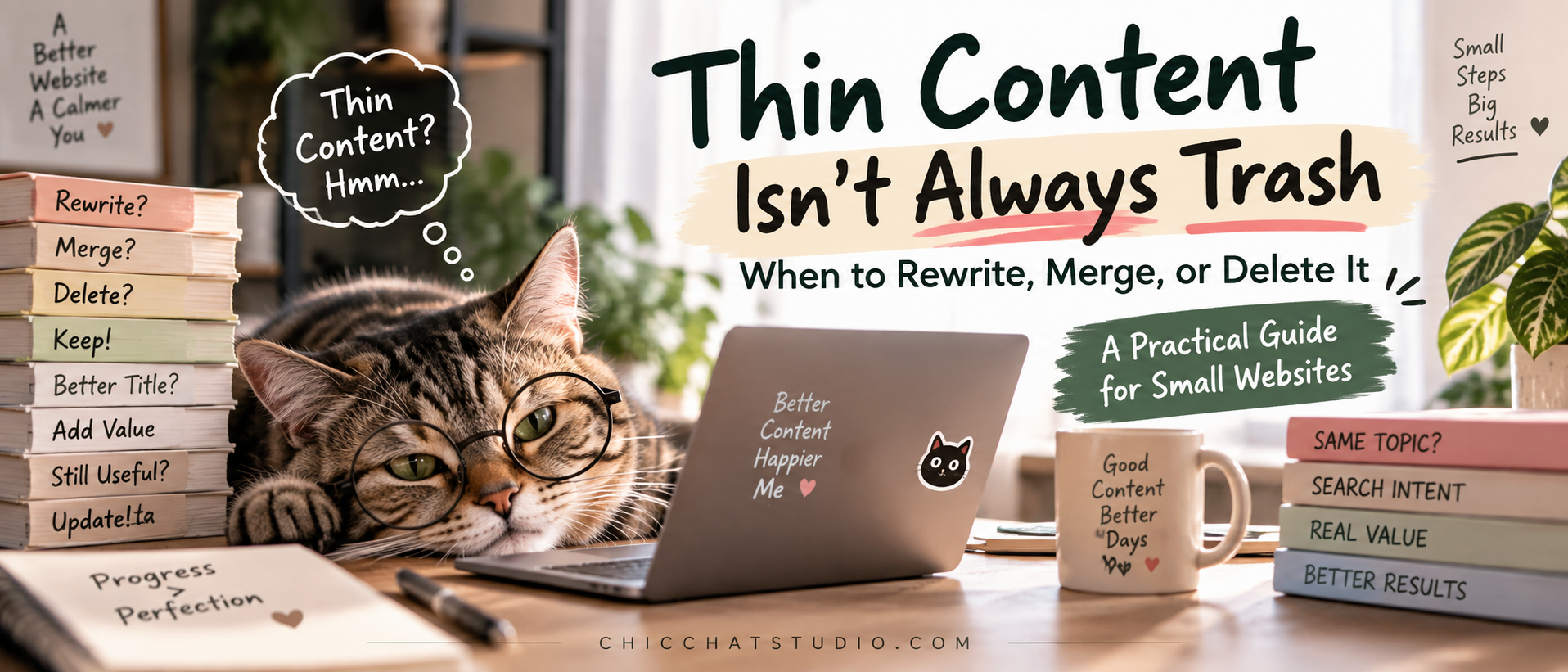
I have fixed tasks for my website every week.
Tuesday is the day I go back and look at old posts.
And honestly, this task can be a bit embarrassing. 🤣
Some of these posts are only a year old, but when I open them now, my first thought is:
What on earth was I writing?
Some sound stiff.
Some go round in circles and somehow still miss the point.
Some make me want to stop halfway through and think:
You know what? Just delete it.
Out of sight, out of mind.
But I’m much less trigger-happy now.
Because I eventually realised something:
Just because I hate reading it now doesn’t mean the article has no value.
Sometimes it simply means I know what I want to say much more clearly than I did a year ago.
I Don’t Start Rewriting the Second I Open an Old Post
I usually read the whole thing first.
I don’t immediately start changing sentences.
I first try to work out:
What exactly is bothering me?
Does the tone feel fake?
Is the content too empty?
Does it say a lot without really answering anything?
Or have my views simply changed since I wrote it?
Sometimes reading an old post feels a bit like finding an ancient Facebook post.
You know you wrote it.
You just don’t particularly want to admit it. 🤣
And sometimes the post looks polished enough on the surface, but there is still something missing underneath. I wrote about that problem in Your AI Article Is Well-Written — And Completely Empty.
So now, the first question I ask when I revisit an old post is not:
How can I make this sound better?
It is:
If someone asked me this question today, would I still answer it this way?
If the answer is no, then yes, the post probably needs work.
But I Don’t Let Embarrassment Make the Decision Either
Because sometimes I hate a post much more than the data does.
So when I review old content, I also look at the numbers.
Right now, I track things like:
Views, Google Clicks, Impressions, Interactions, WA-sourced traffic, Organic traffic and Referrals.
I never judge a post based on one number alone.
Especially not:
0 Clicks
A while ago, I might have looked at that and thought:
Right. Dead post.
Now I look at something else first:
What about Impressions?
If Clicks are sitting at 0 but Impressions are still showing up, I stop.
Because that means Google has at least shown the page in search results.
So the problem might not be:
Nobody wants this.
It could be that the title is not tempting enough.
Maybe the angle is slightly off.
Maybe the article does not quite match what people are really searching for.
Maybe something important is missing.
Or maybe the page is simply not ranking high enough yet to get many clicks.
So now, when I see 0 clicks, I don’t immediately bury the article.
I think:
Hang on. Is this actually dead, or is it just lying there dramatically?
Very different situation. 🤣
I Also Look at What People Are Asking Now
This has become a big part of how I update older posts.
Because sometimes content looks thin not because it is short.
It is thin because:
It is answering last year’s questions.
And people have moved on.
Maybe a year ago people were asking:
“Is this tool any good?”
Now they might be asking:
“How does it compare with AI?”
“Is the free version enough?”
“Do beginners really need it?”
“If I already use something else, do I still need this?”
If I keep seeing the same question coming up and my old article says nothing about it, I do not automatically rebuild the entire post.
I usually just think:
Ah. That’s the bit this article is missing now.
So I add it.
That’s it.
I’m also much less interested now in the idea that:
“This article is thin, so I need to turn it into 2,000 words.”
Why?
If 800 words answer the question properly, great.
If 3,000 words still go nowhere, that is just a longer version of the same problem.
That wider problem of producing loads of content without creating much actual value is something I wrote about in The AI Slop Curve: Why 99% of People Are Working for Nothing Right Now.
So now, when I look at thin content, I am much more likely to ask:
What is this article still missing?
Not:
How many more words can I stuff into it?
So When Do I Rewrite?
This one is fairly simple.
The topic still has value. I just did not write it very well the first time.
That usually means I try to save it.
If it still gets impressions.
If it still brings in a bit of traffic.
Or if people are obviously still searching for the question.
I am not going to kill the whole thing just because Past Me did a dodgy job.
I keep the useful bits.
Cut the waffle.
Replace outdated information.
Add what I actually think now.
Sometimes the topic itself is perfectly fine.
It just needs Present Me to explain it properly.
When Do I Merge?
I’m more careful with this one.
Two posts being in the same broad topic does not automatically mean they should become one article.
What I really look at is:
Are these two posts basically answering the same question?
If they have very similar search intent,
a lot of overlapping content,
and neither one is doing much on its own,
then yes, I might think about merging them into one stronger article.
But if they just happen to live in the same category, I leave them alone.
For example:
Is WordPress good for beginners?
and
What is the first WordPress skill a beginner should learn?
Those are not the same question.
I would rather keep both and link them together.
Otherwise you end up with one enormous article that contains everything and somehow answers nothing clearly.
Delete Is Actually the One I Do Most Slowly Now
I used to be much quicker to want to delete bad posts.
Now I give them another look first.
If I really do delete something, I usually want to see several things at once:
Almost no impressions.
No traffic.
Very little interaction.
The topic itself is outdated.
And even if I started again today, I still would not bother writing it.
That is when I start thinking:
All right. Maybe this one really can retire.
I also ask myself one very simple question:
If I started this website today, would I still write this post?
If the answer is a very clear:
No.
Then deletion starts to make more sense.
But:
“This is embarrassing.”
Does not count. 🤣
That just means you improved.
Small Websites Really Shouldn’t Go on a Deleting Spree
This one matters a lot to me now.
Because cleaning up old content can get weirdly addictive.
This one is bad.
Delete.
That one has 0 clicks.
Delete.
I don’t like this one either.
Delete.
And suddenly, you were supposed to be optimising your site, but somehow you are demolishing the building. 😑
Small websites already have limited data.
If you rewrite ten posts,
merge five,
delete eight,
and change everything at once,
then your numbers move later…
good luck working out what actually caused it.
That’s why I prefer doing this slowly.
I have a fixed day for it.
I look at a few posts.
I change what actually needs changing.
Then I leave things alone long enough to see what happens.
Having fixed containers for different kinds of work has helped me a lot with this in general, which is something I wrote about in I Don’t Need More Inspiration. I Need Better Containers..
For me, this works much better than randomly deciding one afternoon:
Today I shall completely rebuild the website.
Dangerous sentence. 🤣
This Is Roughly How I Decide
| Situation | What I Usually Do |
|---|---|
| 0 clicks, but still getting impressions | Check the title, search intent and content gaps. Usually Rewrite first |
| Some traffic, but the content feels old | Rewrite |
| People are reading it, but common questions are missing | Add content / Rewrite |
| Two posts are basically answering the same thing | Consider Merge |
| Barely any performance, but the topic still matters | Research first. Don’t delete yet |
| No traffic, no impressions and the topic no longer matters | Consider Delete |
| I am simply embarrassed by it | Take my hand off the delete button. 🤣 |
One More Thing: Editing the Post Is Not Always the End
If I am only rewriting the article and the URL stays the same, things are usually fairly simple.
But if I merge or delete something, I still need to clean up afterwards.
For example:
Does the old URL need a redirect?
Are there other posts still linking to that old page?
Do any internal links need updating?
Because I do not want to spend all that time cleaning things up and then leave broken paths all over the site.
And I do not redirect every deleted page to the homepage either.
If I send someone somewhere else, it should actually make sense.
Otherwise they were looking for A,
and I have simply dropped them somewhere random and wished them luck.
I Don’t Automatically Treat Thin Content as Rubbish Anymore
When I first heard “thin content”, the obvious reaction was:
Does this need to be longer?
Now I care much less about that.
What I want to know is:
Did this article actually answer what it promised to answer?
Because thin is not always about word count. Some short posts are extremely useful. Some long posts make you want to close the tab halfway through.
So when I revisit old content now, I usually ask:
What is this article missing today?
That question is much more useful to me than:
How long should this be?
Final Thoughts
I still open old posts on Tuesdays and occasionally think:
Oh, help.
But I no longer assume that because Past Me wrote something badly, the whole post deserves to disappear.
Some posts need rewriting.
Some should be merged.
Some really can retire.
But some are simply:
good ideas that I was not very good at explaining yet.
So I do not really see old posts as rubbish anymore.
I see them more as unfinished assets.
I look at the data.
I look at what people are asking now.
I look at whether I still agree with what I wrote.
Then I decide:
Rewrite, Merge or Delete.
Much safer than seeing 0 clicks and starting a massacre. 🤣