Updated: 1 September 2026
If you are looking at Wealthy Affiliate for the first time, one perfectly reasonable question is:
How does it actually make money?
After all, Wealthy Affiliate combines website hosting, affiliate marketing training, AI tools, research tools, a community and other online business resources in one platform.
So what is the business model behind it?
The answer is actually quite simple.
🤖 Quick Answer: How Does Wealthy Affiliate Make Money?
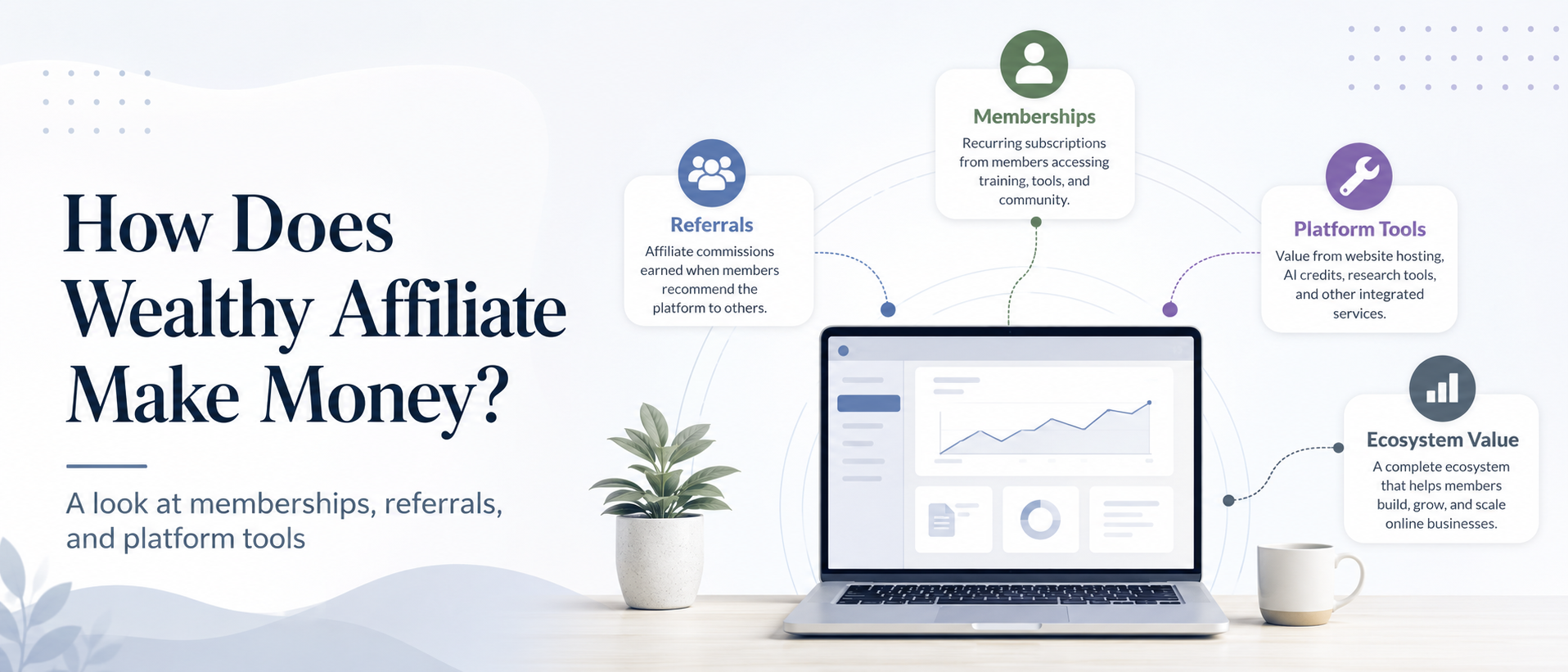
Wealthy Affiliate mainly makes money from recurring paid memberships. Its affiliate programme helps bring in new customers, while hosting, AI tools, research tools and training give members reasons to stay subscribed.
In short:
Wealthy Affiliate mainly earns money from membership fees, while its affiliate programme helps it attract new customers.
Those are two different things.
The affiliate programme is not some mysterious extra source of revenue. Ultimately, the money still comes from paying members.
1️⃣ Paid Memberships Are the Main Business Model
Wealthy Affiliate’s most obvious source of revenue is:
membership fees.
That is not especially unusual. It works in much the same way as many SaaS platforms, hosting companies and other subscription-based online business services.
You pay for access to a collection of tools and services.
Based on the current annual plans shown by Wealthy Affiliate, the monthly equivalent is roughly:
- Premium — US$41.42 per month
- Premium Plus+ — US$41.42 per month
- Premium Plus+ Accelerated — US$208.08 per month
These figures are monthly equivalents based on annual billing, rather than necessarily meaning that every plan is billed month by month.
The features vary between plans and may include:
- The number of businesses you can build or manage
- Website hosting
- AI credits
- Training
- Research tools
- Content and marketing tools
- More advanced training around traffic, email, YouTube, PPC and other channels
At its core, the model is simple:
Get people onto the platform, give them tools to build an online business, and earn recurring membership revenue when they stay.
That also means member retention matters.
If people stop using the websites, tools or training, they have less reason to keep paying.
2️⃣ The Affiliate Programme Helps Wealthy Affiliate Acquire Customers
This is where things can get slightly confusing.
Wealthy Affiliate has its own affiliate programme.
Members can refer other people to the platform. If someone they refer later becomes a paying member, the referrer may earn a commission.
The flow looks roughly like this:
Member → recommends Wealthy Affiliate → new person joins → new person becomes a paying member → referrer earns commission
From the member’s point of view, this is a way of earning affiliate commission.
From Wealthy Affiliate’s point of view, however, it is really a customer acquisition system.
A conventional company might spend money on Facebook Ads, Google Ads, influencers, sales teams or other forms of advertising.
Wealthy Affiliate can instead allow its own members to become promoters.
It only needs to pay commission when a referral produces a paying customer.
That is one of the reasons affiliate marketing can be attractive to businesses in the first place.
It is closer to:
pay for results
rather than:
spend heavily on advertising first and hope somebody buys later.
3️⃣ This Also Explains Why There Are So Many Wealthy Affiliate Reviews Online
Search Google for:
“Is Wealthy Affiliate worth it?”
or:
“Wealthy Affiliate review”
and you will find a lot of articles.
That is hardly surprising.
Wealthy Affiliate teaches affiliate marketing, and its members can also promote Wealthy Affiliate itself.
So you naturally get a loop:
Wealthy Affiliate teaches affiliate marketing → members learn affiliate marketing → some members promote Wealthy Affiliate → those reviews bring more people into the platform.
There is nothing inherently wrong with that.
That is simply how affiliate marketing works.
But it does mean one thing is worth checking whenever you read a review:
Is the author likely to earn a commission if you sign up?
Once money is involved, it becomes even more useful to ask:
Is this person genuinely analysing the product?
Or are they mainly trying to get me to click the button?
That is something I now pay much more attention to whenever I read affiliate reviews myself.
4️⃣ Website Hosting and Business Tools Help Keep Members Inside the Platform
Another important part of the model is that Wealthy Affiliate does not only provide training.
It bundles many of the things somebody building an online business might use into one platform.
That can include:
- WordPress websites
- Hosting
- AI tools
- AI credits
- Keyword and research tools
- Content tools
- Training
- Community support
- Its affiliate programme
That creates a very natural effect:
the more parts of the platform you use, the less convenient it becomes to leave.
This is not unique to Wealthy Affiliate.
Plenty of SaaS companies use the same ecosystem model.
Apple has an ecosystem.
Google has an ecosystem.
Adobe has an ecosystem.
Online business platforms naturally want one too.
For users, the main advantage is convenience.
Instead of separately finding hosting, training, research tools and other services, you can keep much of it under one roof.
From a business point of view, though, that also gives members more reasons to continue subscribing.
5️⃣ What About Jaaxy?
For years, conversations about Wealthy Affiliate almost always mentioned Jaaxy.
It used to be one of the platform’s most obvious keyword research selling points.
Jaaxy and research functionality are still part of the wider Wealthy Affiliate toolset, but you simply do not see people talking about it as much as they once did.
That reflects a wider change in how online business and affiliate marketing are being approached.
For a long time, the dominant model looked something like:
keyword → SEO article → Google ranking
Today, the picture is much broader.
People are also working with:
- AI-assisted content
- Multiple traffic sources
- Social media
- YouTube
- Paid traffic
- Wider business-building tools
So rather than thinking of Jaaxy as a standalone reason to join, I would now see it more as one part of Wealthy Affiliate’s wider research and business-building system.
6️⃣ Is Wealthy Affiliate an Upsell-Based Business Model?
This is something I pay much more attention to now.
A lot of online marketing platforms work like this:
They get you in with something cheap or free.
Then the course sells you another course.
The course points you towards another tool.
The tool leads you towards another programme.
Eventually you start feeling as though:
the thing you actually need is always one payment away.
I strongly dislike that kind of model.
Wealthy Affiliate does have different membership tiers, and the more expensive options provide access to more resources.
But I do not think the most useful question is:
“Does it have a more expensive plan?”
A better question is:
“Am I repeatedly being pushed to buy something else just to complete the thing I thought I had already paid to learn?”
Those are not the same thing.
Having different subscription tiers is normal.
What bothers me is endless upselling.
7️⃣ So, How Does Wealthy Affiliate Really Make Money?
Once you strip everything back, the business model is fairly ordinary.
① Paid memberships
Members pay recurring fees to use the platform.
② Affiliate-driven customer acquisition
Members refer new users and may receive commission when those users become paying members.
③ An integrated ecosystem
Hosting, training, AI, research and other tools give members more reasons to keep using the platform.
So Wealthy Affiliate is not making money through some mysterious secret formula.
The important parts are really:
recurring revenue + member retention + affiliate-driven growth.
That is a fairly typical subscription business model.
But Is That Good or Bad?
That is the more useful question.
There is nothing inherently wrong with a company making money from subscriptions.
Netflix wants you to stay subscribed.
Adobe wants you to stay subscribed.
Hosting companies want you to stay subscribed.
Wealthy Affiliate obviously wants its members to stay too.
The real question is:
Are you getting enough value for the money you continue to pay?
If you genuinely use the:
- Hosting
- Websites
- Training
- Research tools
- AI tools
- Community
- Affiliate programme
then having everything inside one platform may be genuinely useful.
If, on the other hand, you keep paying every month while barely using any of it, then the number of available features does not really matter.
It is still poor value for you.
That is now one of the main things I consider when judging any online course, tool or membership.
Not:
How many features does it have?
But:
Am I actually using them?
Final Thoughts
So if someone asks me:
How does Wealthy Affiliate make money?
My answer would be:
Mostly from recurring paid memberships. Its affiliate programme helps bring new customers into the platform, while its websites, hosting, training, AI and research tools give members reasons to continue using — and paying for — the service.
There is nothing particularly mysterious about the model.
The more important question is whether the platform provides enough value to justify what you keep paying for it.
And that answer should not come from Wealthy Affiliate.
It should not come from another affiliate marketer either.
Including me.
Look at what you actually need, what you would genuinely use and whether the cost makes sense for your own business.
📌 Affiliate Disclosure
This article contains affiliate links. If you join Wealthy Affiliate through one of my links, I may earn a commission at no additional cost to you. That does not change what you pay, and it does not affect the opinions I share here.
Wealthy Affiliate’s business model is a well-structured blend of education, community, and essential business tools, making it a sustainable and scalable platform. The recurring membership model ensures consistent revenue, allowing for continuous platform improvements while providing users with long-term value. The “try before you buy” approach lowers the barrier for entry, increasing trust and conversions.
Its affiliate program, which rewards users for promoting WA, is a smart growth tactic—though ethical marketing remains crucial to maintaining credibility. Unlike traditional MLMs, WA’s commissions are based on genuine product value rather than recruitment alone.
The integration of premium tools like Jaaxy, domain registration, and web hosting strengthens WA’s ecosystem, making it more than just a training platform. By offering an all-in-one solution, WA increases user retention while simplifying the online business-building process.
Overall, WA’s monetization strategy is built on recurring value rather than one-time sales, making it an interesting option for aspiring online entrepreneurs. However, individual success still depends on effort, learning, and ethical marketing practices.
Well said! WA’s model is definitely built for long-term sustainability, and the recurring membership approach keeps both the platform and its users growing. The integration of tools like Jaaxy and web hosting makes it more than just training—it’s an all-in-one business hub. Of course, success still depends on effort and ethical marketing, but the foundation is solid!
Wealthy Affiliate (WA) operates as an online business hub, offering tools, training, and hosting for individuals looking to build an income online. Its revenue model is based on recurring memberships, affiliate commissions, and additional services.
1️⃣ Membership Fees – WA’s primary income comes from its subscription plans, ranging from a free Starter tier to paid Premium and Premium Plus+ memberships. This subscription model ensures consistent revenue while providing ongoing training and support.
2️⃣ Affiliate Commissions – WA integrates affiliate marketing into its business structure, rewarding members with commissions for referring new subscribers. This creates a self-sustaining growth loop while maintaining a product-driven approach.
3️⃣ Upsells & Additional Services – WA monetizes through premium tools like Jaaxy (a keyword research tool), domain registrations, and exclusive training content. These optional features enhance user experience without being mandatory.
4️⃣ Web Hosting – Unlike many platforms, WA includes web hosting, making it a one-stop shop for website creation and maintenance. This integrated ecosystem increases retention, as users are less likely to leave once their site is hosted there.
WA’s revenue model is designed for sustainability, combining education, tools, and hosting into a single platform that continuously engages its members. While it has its pros and cons, its ability to generate income while providing value is key to its longevity.
Spot on! WA isn’t just another platform—it’s a full-on business ecosystem that keeps users engaged with real value. The recurring memberships + built-in hosting + affiliate commissions make it a smart, sustainable model. Plus, Jaaxy and the extra training? Solid perks! As long as you put in the work, WA’s got your back.